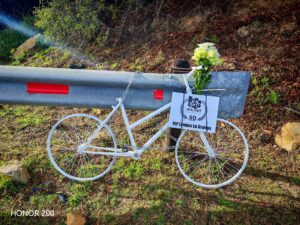




Ghost Bikes
The modern ghost bike movement originated in St. Louis, Missouri, in 2003, but its concept draws from earlier art projects and 1960s anarchist roots.Today, these junked bicycles are stripped, painted completely white, and locked near crash sites as roadside memorials for cyclists killed or injured by motor vehicles. They also serve as a public warning to motorists to share the road safely.
1965: The Anarchist Roots in Amsterdam
The visual concept of painting bicycles entirely white began with an anarchist counterculture group called Provo in Amsterdam. In 1965, they introduced the White Bicycle Plan, leaving free white bicycles across the city to combat pollution and provide public transportation. In 1966, the group initiated the “White Victim Plan,” where they filled the silhouettes of cyclists killed by cars with white mortar on the roads.
2002: The San Francisco Art Project
In April 2002, San Francisco artist Jo Slota began a purely artistic project. Fascinated by abandoned, stripped bicycle frames locked up around the city, he began painting them white and documenting them on his website, ghostbike.net. While it was not initially a memorial project, it heavily inspired the aesthetic of the movement.
2003: The First Memorial Bike in St. Louis
The first recorded instance of a white bike used specifically as a crash memorial occurred in April 2003. After witnessing a motorist strike a cyclist in a dedicated bike lane in St. Louis, bike mechanic Patrick Van Der Tuin placed a white-painted bicycle at the scene. It featured a hand-painted sign reading “Cyclist Struck Here”.Seeing the impact of the visual, Van Der Tuin and his friends created the project “Broken Bikes, Broken Lives,” placing 15 more bikes at prominent crash sites around St. Louis to highlight unsafe traffic conditions.
2004–Present: Coining the Term and Global Expansion
Pittsburgh (2004): A local community bike cooperative spearheaded by activist Eric Boerer adopted the St. Louis concept. This group officially coined the phrase “ghost bike” and registered the central registry archive GhostBikes.org.
New York City (2005): The movement expanded heavily to New York City following the death of cyclist Liz Padilla. This led to the formation of the NYC Street Memorial Project.
Global Presence: The initiative quickly evolved into an international phenomenon. There are currently over 630 ghost bikes placed across more than 200 locations worldwide, including major cities across Europe, the Americas, and South Africa.
11 June 2024 – Calib De Kock
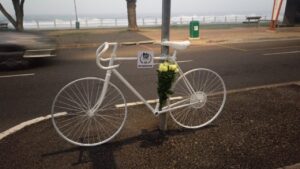
1 July 2025 – Danilo Waena
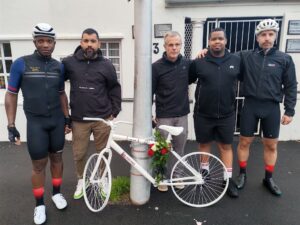
27 July 2025 – Dennis Hammar
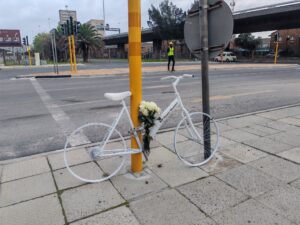
2 August 2025- Allen Cox
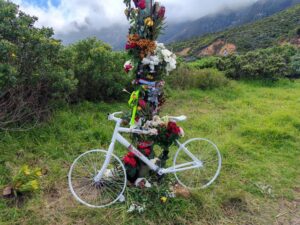
16 December 2025 – Idries Sheriff
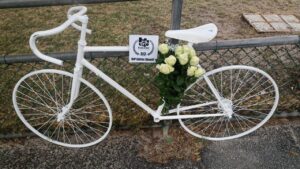
8 Feb 2026– In memory of Richard Da Silva, Jarrod Dwyer, Veven Naidoo and Craig Diedericks who all lost their lives on this stretch of road.
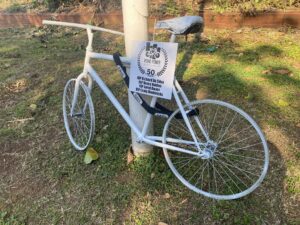
2 February 2026 – Sanele Mhlungu
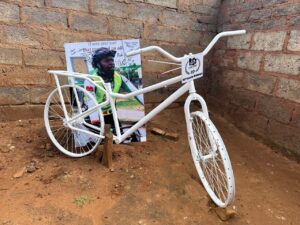 .
.
7 April 2026- Landon La Grange